The bay is the first thing you see at Tivat. By the time your bag is off the belt somebody has already opened maps to find the transfer, and that is usually when the phone buzzes with a text from your operator about roaming charges, which most people decide to read later. The rest of the holiday is familiar: Kotor and Budva, the view down onto Sveti Stefan, a boat trip, a day over the border into Albania because it is right there. The one part that does not behave like a European holiday is the phone.
Europe on the map is not Europe on your bill
Montenegro is not in the European Union. Neither is Albania. UK customers no longer have an automatic right to EU roam-like-at-home rates, so what you get abroad depends on your operator and plan.
The catch is that inclusive roaming is sold as a list of countries, usually badged as a Europe zone, and that list is a commercial decision rather than a map. Places on the Adriatic that feel obviously European can sit outside it, and these two often do.
The Western Balkans have a separate regional roaming agreement for subscribers from the region. Lower data rates between participating EU and Western Balkan operators are a different arrangement. Neither gives a UK number an automatic entitlement to inclusive roaming.
Check whether your plan includes either country and what any extra use costs. Your operator’s current tariff is the place to start. Search your account for Montenegro and Albania by name, and note three figures:
- what a megabyte of data costs, or what the daily charge is,
- what a text costs,
- what it costs to answer an incoming call.
The third catches people out, because outside an inclusive zone receiving a call can be billed as well as making one.
That leaves three options. Accommodation Wi-Fi can help, but it will not follow you to the beach or on a drive to Perast. A local SIM may offer good value if you are happy to visit a shop and complete the registration. A travel eSIM can be installed before departure and lets you keep your usual line on a compatible phone.
One plan, or one for each country
This is the question the Albania day trip creates.
If you are staying in Montenegro, compare the country plan first. If Albania is definitely on the itinerary, check the regional Balkans plan and make sure both countries are listed. If you are flying into Dubrovnik and driving down through Debeli Brijeg, check for Croatia too. The name of a regional package is not a substitute for its country list.
What a Montenegro plan does not do is follow you across. It does not break and it does not charge you anything. You cross at Sukobin to Muriqan on the road down from Ulcinj, or at Božaj to Hani i Hotit on the Podgorica road, and you should not expect a Montenegro-only plan to provide data in Albania. For one day out of fourteen, with an offline map and a pre-agreed meeting point, that is reasonable. Just decide before you set off, not in the queue at the crossing in August.
If the day trip involves a hire car, ask the rental company about the border in advance: it has to be arranged, with paperwork.
How much data a week on the coast needs
It is easy to underestimate maps, uploads and video calls, or buy far more data than you need. Use these ranges as rough planning estimates, with extra room for video and hotspot use:
| What you are doing | Per day |
|---|---|
| Maps, messaging and email | 100 to 200 MB |
| Plus social scrolling | 300 to 500 MB |
| Plus video calls and short clips | 700 MB to 1.2 GB |
| A laptop on a hotspot all day | 1.5 GB and up |
As a starting point, allow 1 to 3 GB for a long weekend and 3 to 5 GB for a week of light use. For a fortnight, or if you intend to share the connection with the rest of the family, consider 10 GB or more, depending on how much time you spend on video and how often Wi-Fi is available. Whether sharing works at all depends on your phone and on the plan, so check it rather than build the week around it.
Two settings matter more than plan size: turn off video autoplay in social apps, and set photo backup to Wi-Fi only. After an afternoon at Bečići the phone quietly uploads hundreds of pictures nobody has looked at.
Reception in the bay and on the winding roads
Reception can change as you move between towns, mountain roads and the water. Plan for interruptions on excursions, even if the connection at your accommodation is fine.
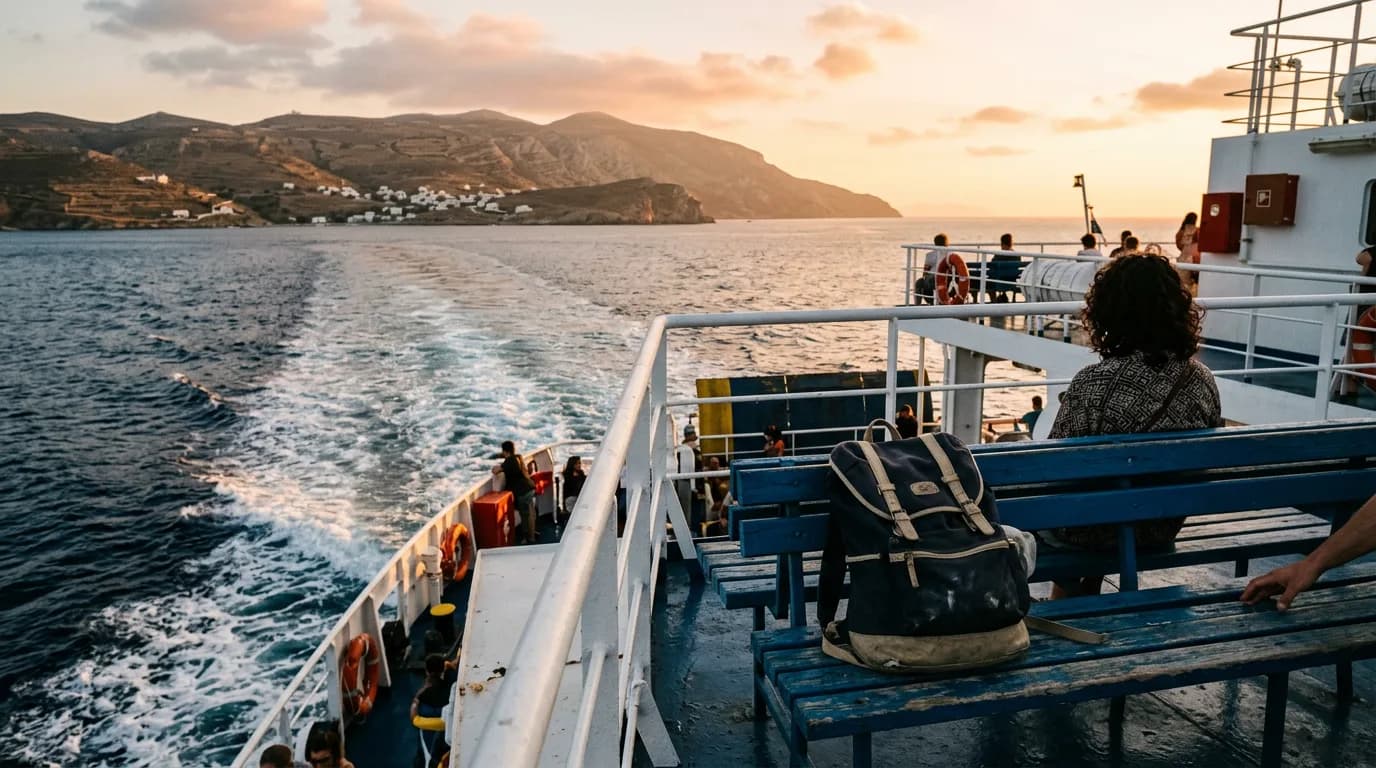
The Bay of Kotor has steep slopes and sheltered inlets where reception can vary. On boat trips and on the Kamenari to Lepetane ferry, keep tickets and meeting details available offline.
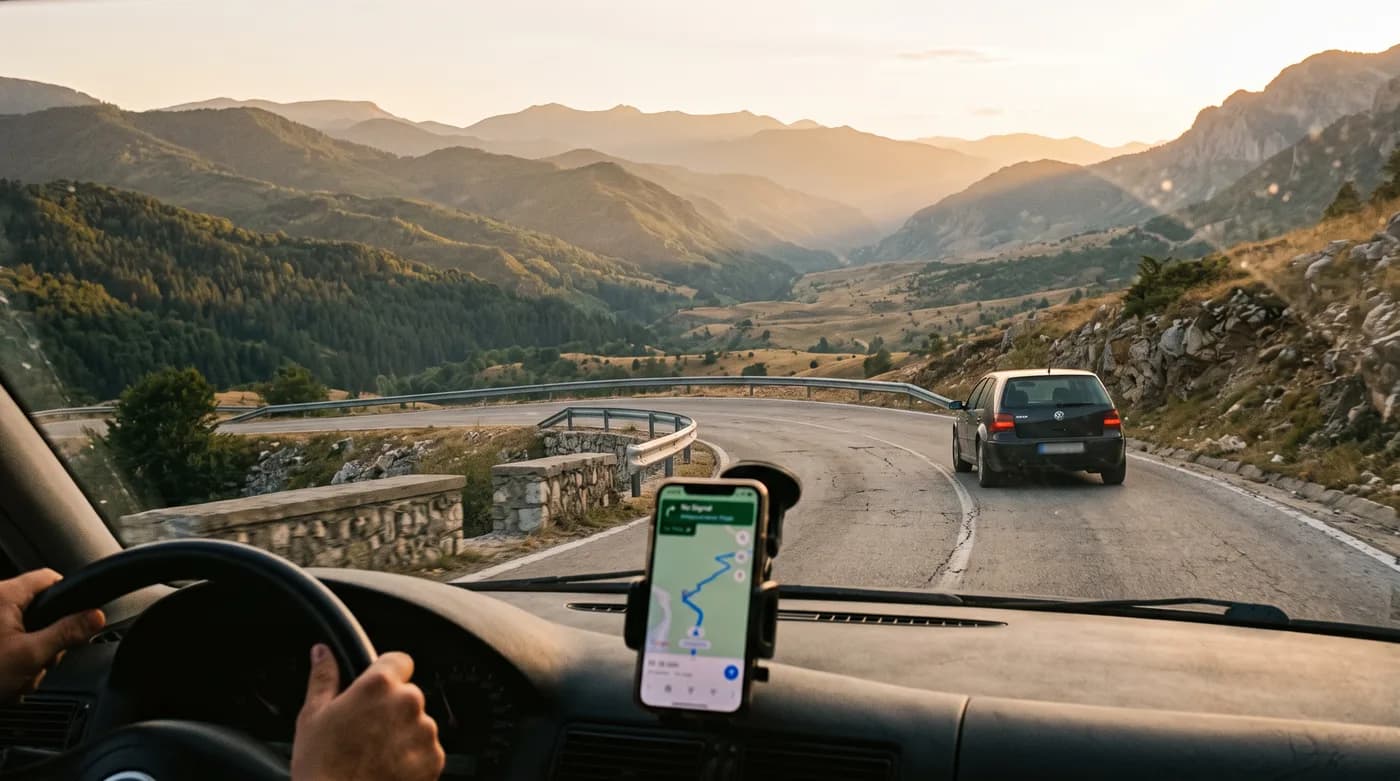
The road up to Lovćen. The hairpins above Kotor towards Njeguši are the best view of the trip and the worst place to be prodding at a phone. Download the map before you climb.
Boat trips. Our Lady of the Rocks off Perast, the Blue Cave on Luštica, Lake Skadar from Virpazar. Out on the water you are further from the masts than you think, so download anything you want to look at before you board.
Inland and over the border. Tunnels, the Morača canyon north of Podgorica, and mountain roads beyond Shkodër towards Koman or Theth can bring interruptions. Reception depends on the terrain and available network, so download the route before you leave.
The fix is free: download offline maps of Montenegro, and northern Albania if you are crossing, before you leave home.
Which network you end up on
The plan connects through partner networks, and those arrangements can change. Your phone normally selects an available supported network automatically; it is not guaranteed to use the strongest signal or switch immediately if reception drops.
If nothing connects when you land, go in order. Mobile data on the eSIM line. Data roaming switched on for that line, which feels backwards but is required, because the profile joins as a guest on a local network. Then toggle aeroplane mode. If it still will not register, search for networks manually and try a partner network supported by your plan.
Your number, your bank and paying for things
Keep your usual SIM enabled so your UK number can receive calls, texts and bank codes, provided roaming service is available on that line. WhatsApp keeps its existing number while using the travel eSIM for data. Turn data roaming off for your UK SIM before arrival and disable automatic data switching if your phone offers it. Calls may still incur charges.
Montenegro uses the euro despite not being in the EU, while Albania uses the lek, so it is useful to carry some local cash for the day trip. If your bank asks you to approve a payment in its app, you will need an internet connection to do so. Some coastal car parks are paid by text to a local short code, which a foreign number may not manage, so keep coins handy in Kotor and Budva.
Does your phone support eSIM?
eSIM support depends on the exact model and sales region. Many iPhones from the XR generation onwards support it, but check imported variants carefully. Android support varies too, even among recent mid-range models.
Look for Add eSIM in the mobile or SIM settings, and check the manufacturer’s specifications for your exact model. A missing option does not by itself diagnose a network lock. UK providers can no longer sell locked handsets, but older, second-hand or imported phones may still need unlocking.
Before you fly
Install the profile at home while you have Wi-Fi. Standard validity starts on first connection at the destination unless the plan states otherwise, so read its activation conditions before installation.
- Check your operator's charges for Montenegro and Albania by name.
- Check the phone takes an eSIM and is not network locked.
- Decide whether Albania is happening, and check that your chosen plan includes it.
- Install the profile at home on Wi-Fi.
- Download offline maps of Montenegro, and northern Albania if you are crossing.
- Turn off video autoplay and photo backup on mobile data.
- On arrival: data on the eSIM line, roaming on for it, roaming off for your own SIM.
A little preparation at home means you can read that roaming message at Tivat knowing which line is handling your data.
Topics
- montenegro
- albania
- adriatic
- roaming
- esim